

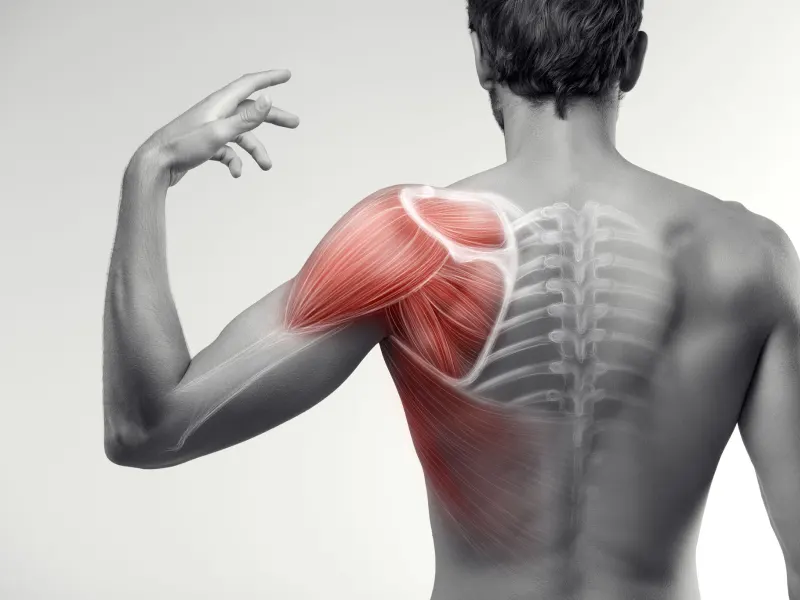
Shoulder injuries are widespread and account for more than six and a half million ER visits per year in the US. That’s not including chronic issues, which are more common in the shoulder than acute injuries. The joint as a whole is very mobile yet often unstable, which helps explain the many injuries. The shoulder complex is actually made up of three joints, formed by three bones and supported by seventeen muscles. The bones are the clavicle (collarbone), scapula (shoulder blade), and humerus (upper arm bone). The three joints are the glenohumeral, the acromioclavicular, and the sternoclavicular. The glenohumeral joint is between the humerus and the scapula, and this is what most of us think of when we talk about the shoulder: the ball-and-socket joint. The acromioclavicular, or AC, joint sits right above the glenohumeral. It is formed by the outer end of the clavicle and a portion of the scapula called the acromion process. This is the joint that is injured when you “separate your shoulder.” The last joint is often forgotten, yet it is essential. The sternoclavicular, or SC, joint is made from the other end of the clavicle and the sternum.
We don’t need to go through all of the individual muscles, but understanding a few groups will be helpful. The first group is the rotator cuff muscles. The rotator cuff is actually made up of four different muscles: the supraspinatus, infraspinatus, teres minor, and subscapularis, or the SITS muscles for short. These muscles help keep the humerus in the glenoid fossa, forming the glenohumeral joint. The “ball” is too big for the “socket,” so this joint looks more like a golf ball on a tee. As the humerus rotates, the SITS muscles all keep the “ball” from rolling off the tee, or “socket.” The other muscle group we need to know is the scapular stabilizers. This is a group of muscles that all stabilize the scapula. The scapula is almost free-floating on your back, with very few bony attachments. Because of this, many muscles attach and hold it together. In our office, we often refer to the scapular stabilizers as the “core” of the shoulder.
Shoulder injuries are usually very complex and rarely have a simple answer. That’s why at Northern Lakes Chiropractic, we mix multiple treatment types to help patients get the results they deserve. It’s more than just one injection for pain. It’s more than just a “simple” surgery to “clean out” the joint. We will treat the entire joint and the entire person, helping them reach the goals they set. Shoulder injuries can be daunting and scary, but they don’t have to be. By understanding the problem, we can create real solutions to get lasting results.
$97 New Patient Special
Includes Consultation, Digital AI Range of Motion Analysis, Digital Posture Analysis, Digital X-rays & Report of Findings
How Our Care Plan Works
1. Discover The True Root Cause
We look beyond where you feel symptoms to understand what is actually causing them. Instead of offering a short-term answer, we focus on correcting the problem at its source to create long-term solutions and lasting results.
2. Finally Get Real Solutions
We are not here to simply manage symptoms or provide quick fixes. Our focus is on understanding the true reason behind your condition and correcting it, helping you move beyond the Band-Aid approach and toward lasting, meaningful results for your health.
3. Have The Freedom To Fulfill Your Dreams
Your goals become our goals. We are a goal focused practice helping you achieve the health so many people struggle with today. With better health comes the freedom to go after the dreams you’ve set out to achieve.
How We Treat Shoulder Pain In Duluth, MN
We have a variety of treatments for shoulder pain in our clinic. Our treatment protocols take a holistic approach to address the underlying cause of your shoulder pain.
Comprehensive Consultation and Exam
This is where we start the process to truly understand how we can help you get real, long-lasting results. Our process at Northern Lakes Chiropractic starts with sitting down with you so we can understand your specific shoulder pain. There are a variety of issues that can cause shoulder pain, so we will perform an examination that includes digital range-of-motion testing, AI posture analysis, muscle testing, and, if needed, X-rays. This examination process will help us confirm exactly what is causing your shoulder pain, so we can create the best plan of action to correct the root cause. We do not provide band-aid types of treatment in our office, so getting to the root cause is our sole focus in getting you the best long-lasting results.
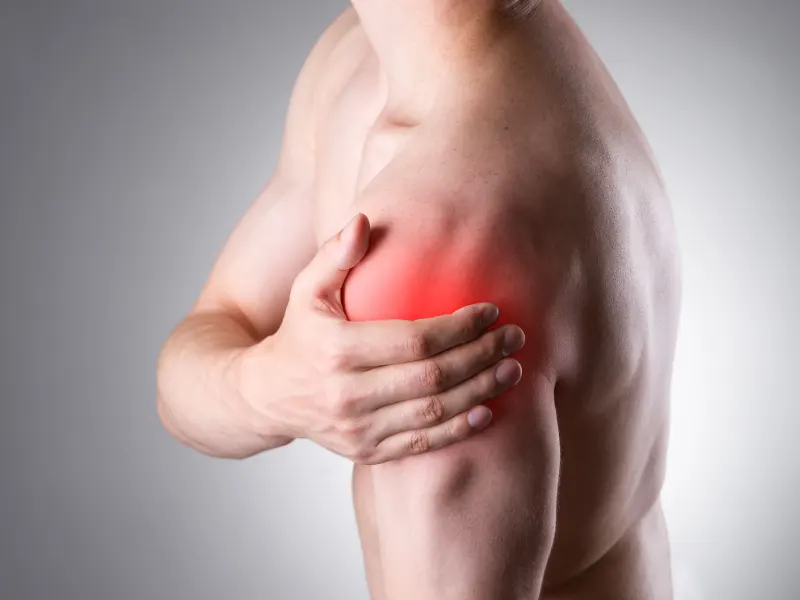
Digital X-rays
X-rays are an important tool for understanding your shoulder pain. X-rays give us a detailed picture of the shoulder, and by seeing exactly what is going on, we get the best idea of how to treat your shoulder pain. X-rays are a valuable diagnostic tool and are low risk, thanks to the modern digital X-ray equipment at Northern Lakes Chiropractic. To see is to know, and to not see is to guess; we do not guess when it comes to your health.
Specific Chiropractic Care Duluth, MN
Spinal subluxation (misalignment) happens when one or more of the vertebrae in the spine become misaligned, causing pressure on the adjacent nerve. This interrupts the signal from the nerve trying to communicate with the rest of the body. When nerves are irritated, your body sends a signal in the form of pain. Shoulder pain is one of the most common types of pain that can be associated with subluxation of the neck. The nerves that come from the neck directly affect the muscles and structures that make up the shoulders. One of the biggest causes of shoulder pain is called tech neck. Tech neck comes from the straightening of the cervical (neck) spine. Normally, we have a gradual curve in our neck to help support the weight of the head. The digital age has caused people, on average, to look down more today than ever. This process of consistently looking down straightens the neck curve. When the neck is straight, we lose the ability to properly distribute the weight of the head, which can lead to increased tension in the shoulder from the neck not sitting in the right position. A peer-reviewed study in the Indian Journal of Orthopaedics cites the estimate that for every inch of forward head posture (how far the head sits forward of its normal position), the load on the neck and shoulder muscles increases by about ten pounds. This will increase the rate of fatigue in the muscles that make up the structure of the neck and shoulders, which can cause shoulder pain. The easy way to think about this is to imagine holding a ten-pound bowling ball close to your chest. It would not be all that hard to hold it there for ten minutes without your muscles fatiguing. But if you start to hold that bowling ball out inch by inch, it will get harder to hold, and your muscles will continue to fatigue at a faster rate, leading to more pain, aches, and injuries due to the stress.
Your head works in a similar way. As it sits farther forward past your shoulders, your neck and shoulder muscles have to work more to support you. Over time, this leads to extra work that may contribute to muscle fatigue and discomfort.
Northern Lakes Chiropractic is the only chiropractic office in the Northland certified to use the Torque Release Technique. This technique does not use the traditional twisting or cracking of the neck. We use a tool called the Integrator, which produces a more precise and accurate adjustment than older techniques. Results from this technique for shoulder pain are typically much better due to its specificity. We not only see results happen faster but also see them last much longer, on average, compared to traditional techniques.
Chiropractic care provides a non-invasive and drug-free approach to managing and alleviating shoulder pain. By correcting spinal misalignments, chiropractic adjustments can reduce nerve compression, improve mobility, and enhance overall spinal health. Patients often experience pain relief, increased flexibility, and improved range of motion, leading to an enhanced quality of life. Chiropractic treatment can also help reduce symptoms like numbness, tingling, and pain.
During the treatment, Dr. Bryce Benson uses a gentle, non-twisting method to adjust your neck. This technique involves precise, controlled movements to align the vertebrae without the traditional “cracking” commonly associated with chiropractic adjustments. This approach is both effective and comfortable.
Custom Therapeutic Exercise Plan
A key piece to helping correct shoulder pain is a custom therapeutic exercise plan. The shoulder joints by nature are not the most stable joints. If we want to stop shoulder pain and keep it from coming back, we need to strengthen and stabilize the joint. Shoulder pain can be caused by a plethora of different things. Once we are able to treat and help correct the area, we will send you exercises to help with your specific shoulder pain. At Northern Lakes Chiropractic, we do not have a one-size-fits-all approach to shoulder pain; we focus on your individual needs because everyone needs a personalized plan to get the best long-lasting results.
HydroWave Therapy
We found that most traditional options today for shoulder pain include drugs, injections, or surgery. This did not sit well with us at Northern Lakes Chiropractic, and we decided to find a better solution. Our mission was to find something that would give patients real results that would last and not just another cover-up that would only make the problem worse over time. We have found that with HydroWave therapy, results have been amazing, helping the body repair at a rapid rate without the need for surgery or injections. This therapy works great with chiropractic because chiropractors focus on the osseous (bone) part of the joint. We can use this therapy to help with damage around the joint that needs additional help healing, which is where HydroWave is so highly effective in supercharging the healing and offering a quick, non-invasive, effective treatment that is long-lasting.
HydroWave therapy is a more advanced, non-invasive treatment that uses shockwaves to rapidly accelerate the body’s natural healing process by triggering regenerative cells. HydroWave achieves this by sending short, rapid bursts of highly focused acoustic pressure waves into soft tissue that is injured, scarred, inflamed, or causing different types of pain.
By supporting circulation, tissue healing, and elasticity while helping calm inflammation, HydroWave can be a valuable tool for helping damaged or irritated tissues recover and function better.
How Exactly Does It Work?
Physical Effect
The physical effect happens by using a gentle pressure wave that stimulates the tissue at a deep level. The physical force stimulates blood flow, breaks down scar tissue, and advances the movement of lymphatic drainage. These effects lead to reduced swelling, decreased inflammation, increased circulation, and improved tissue elasticity.
Chemical Effect
At a chemical level, HydroWave helps promote healing in three ways.
- Collagen: An increase in collagen production helps support skin, muscles, and ligaments because collagen is the main protein supporting those structures.
- Growth factors: An increase in growth factors boosts repair at a cellular level and helps promote the production of new, healthy tissue.
- Inflammatory markers: A reduction in inflammatory markers helps speed up the healing process and decrease overall pain and discomfort.
Biological Effect
HydroWave shockwave therapy triggers a cascade of healing responses at a cellular level. The therapy triggers the activity of fibroblast and osteoblast cells, which are responsible for healing and regenerating connective tissue and bone, resulting in less scar tissue, faster tissue repair, and improved joint mobility. During treatment, natural endorphins are released, which gives you near-instant pain relief because endorphins are the body’s natural painkillers.


Common Causes of Shoulder Pain in Duluth, MN
Bursitis
What is a bursa? A bursa is a fluid-filled sac that is made to help a tendon and/or joint move more easily. Its purpose is to reduce friction with movement. The suffix “-itis” means inflammation or inflamed. So, bursitis is simply an inflamed bursa. Because the shoulder is such a mobile joint, it has five primary bursae that aid in proper movement. Any of these bursae can become inflamed, leading to bursitis. Most patients describe bursitis as dull or aching pain, occasionally burning. This pain is typically worsened by movement and can sometimes cause tenderness, swelling, or a warm feeling in the joint.
To treat bursitis, you first need to decrease the inflammation around the irritated bursa. At Northern Lakes Chiropractic, we do this through shockwave therapy. Once this inflammation is under control, you need to correct what first irritated it. This is usually some sort of muscular imbalance. This could be a tight or weak muscle, or a combination of both. This is addressed through a personalized at-home exercise program to correct any imbalances.
And throughout this treatment, we will be adjusting the shoulder, thoracic spine, and cervical spine. Any changes in the range of motion of these joints will create further issues, either continued bursitis symptoms or something more sinister. Adjustments will correct this range of motion and proprioception through these joints.
Frozen Shoulder
Frozen shoulder is technically known as adhesive capsulitis. It feels exactly like it sounds, where the shoulder becomes “frozen,” commonly causing shoulder pain. If we break down the technical name: adhesive—meaning stuck together; capsule—the connective tissue casing that surrounds the joint; and “-itis”—meaning inflamed. Patients will have a minimal range of motion, which is usually very painful when attempted.
Frozen shoulder usually starts as another joint injury, such as tendonitis, bursitis, or a rotator cuff injury, that isn’t adequately treated, and the patient stops moving the joint more and more to try to protect the injury. The joint attempts to defend itself, and it slowly starts to lock up or freeze, forming adhesions around the joint. These often progress until the patient seeks treatment for the frozen shoulder. It can also be a metabolic disorder, meaning your body is struggling to break down what you consume and responds with an inflammatory response, like a frozen shoulder. There are other causes, but these are the most common.
Treatment is often a long process, but keep in mind that this disorder has taken a long time to progress to the point of frozen shoulder. The best treatment uses shockwave therapy, which helps break down adhesions and “melt” away the frozen shoulder. Adding in adjustments to the shoulder and thoracic spine is crucial for re-establishing proper mobility. At Northern Lakes Chiropractic, we also send patients home with a specific rehabilitation program to work through mobility and then stability exercises.
There are medical treatments for frozen shoulder, but these usually start with procedures such as cortisone injections, aimed at reducing inflammation and improving the patient’s range of motion. These have very low success rates, require the patient to be very diligent with their home stretching, and are usually excruciating. The most extreme version of medical treatments includes the patient being put under general anesthesia, then the provider forces the shoulder to move, ripping the adhesions. If you watch videos of this procedure, it sounds like Velcro ripping. This usually leaves the patient very sore and still needing to go through a complete rehabilitation program afterwards to retrain the muscles to move after the trauma they went through during the surgery.
Frozen shoulder is an excruciating condition and leaves the patient with limited ability to use that arm. It is essential to treat shoulder conditions promptly, before they progress. Proper care can help return the patient to everyday life.
Osteoarthritis
Osteoarthritis is the type of arthritis that is usually acquired, meaning the patient spent enough time overworking that joint to create signs of osteoarthritis (OA). The good news is that OA is rarely a pain generator. It is more common to present in conjunction with another cause of pain. So, the best treatments for OA are those that identify the true pain generators and the muscular and movement imbalances that lead to OA, and correct them.
When OA is the true pain generator, it usually leads to some sort of shoulder impingement, meaning the arthritis has progressed to a point that limits the movement of either the muscles/tendons or the joint itself. Conservative treatment for this usually includes reducing surrounding inflammation and hoping that it relieves symptoms. If that doesn’t work, it is common to progress to medical intervention. This may mean injections or surgery. But even with these avenues, it is essential to correct the imbalances post-surgically to prevent the issue from returning. The surgery may remove the osteophytes that are causing the impingement, but it doesn’t correct the movement pattern that created the osteophytes in the first place.
Rotator Cuff Injuries
Rotator cuff injuries are prevalent, with most research showing that more than twenty-five percent of Americans will have a rotator cuff injury at some point in their lifetime. The rotator cuff is a group of muscles known as the SITS muscles. SITS stands for supraspinatus, infraspinatus, teres minor, and subscapularis. The primary shoulder joint, the glenohumeral joint, is a ball-and-socket joint. But if we were to describe it more accurately, it’s more like a golf ball sitting on a tee. The “ball” is much bigger than the “socket.” The SITS muscles help keep the golf ball from rolling off the tee. These are all small muscles primarily used for stabilization, not for movement. A large majority of rotator cuff injuries happen in patients who demonstrate poor scapular stabilizers. Previously, we discussed how the scapular stabilizers are the “core” of the shoulder. Weakness in the scapular stabilizers will force the rotator cuff muscles to engage more in movement than in stability, placing greater load on them than intended, and eventually leading to injury.
Conservative treatment is more successful at treating rotator cuff injuries than conventional medical care. Injections and surgery have very low success rates, while the treatments we provide at Northern Lakes Chiropractic continue to prove their effectiveness. The first step when treating rotator cuff injuries is to decrease inflammation in the injured tissues. Once we reduce pain and inflammation, we move on to loading the SITS muscles and strengthening the scapular stabilizers. Creating a specific rehabilitation program for each patient will provide the tools needed to help them progress toward their goals. Throughout the entire treatment, we will adjust both the shoulder and the thoracic spine. These joints work synergistically to maintain proper mobility and stability, and having adequate motion and proprioception is crucial for achieving long-term results.
Sprain
What is the difference between a sprain and a strain? Simply put, a sprain is a damaged ligament, while a strain is an injured muscle or tendon. The most common type of shoulder sprain, the acromioclavicular (AC) sprain, is also known as a separated shoulder. These are usually diagnosed by orthopedic examination and confirmed on X-ray.
Most treatments for a separated shoulder are palliative, meaning they are just trying to decrease the pain and eventually the inflammation. The severity of the sprain is graded from one to six, with grade one being the least severe and grade six the most severe. Once inflammation has decreased, it is essential to strengthen the surrounding muscles to support the joint, as the ligaments will not be able to stabilize as they were designed to. This is done by increasing strength in both the rotator cuff muscles and the scapular stabilizers. In extreme cases, surgery may be performed, and a screw or plate may be placed across the AC joint to provide stability.
Tendonitis
Tendonitis is inflammation of a tendon. With seventeen different muscles that move the shoulder, seventeen different tendons could become inflamed, leading to shoulder tendonitis. It is usually described as a dull, aching feeling, soreness, or even a sharp pain directly in the tendon. Tendonitis is generally caused by overuse. This may happen when there is a quick or sharp increase in training or use.
Treatment is initiated with modalities to reduce pain and allow the patient to continue loading the tendon. Then loading the tendons through some isometric exercises and progressing to eccentric loads will increase tendon strength, preventing it from returning or becoming chronic.
Tendonitis can be prevented by creating training programs that progress appropriately and by continuing to incorporate stabilization exercises into programming.
Frequently Asked Questions
Can chiropractors help with shoulder pain?
Maybe—it really depends on what is causing your shoulder pain. The best thing you can do is come in, and we can either work on finding a solution for your shoulder pain in the office or refer you to the best place possible.
Should I see a doctor or chiropractor for shoulder pain?
Chiropractic can be a great place to start because the treatment is going to be non-invasive and low risk.
Why is my shoulder pain not going away?
There could be a number of reasons that shoulder pain is not going away. Only through a consult and running through an examination process can we find the answer to that question.
What could shoulder pain be a sign of?
Shoulder pain is commonly a sign of a compressed or irritated nerve, which sends consistent pain signals to the shoulder.
How do I stop severe shoulder pain?
There are a lot of different treatment options, but one of the best places to start is chiropractic because it is non-invasive and low risk. At Northern Lakes Chiropractic, we have a network of providers we refer to if it is something we cannot help with.
What does a pinched nerve in the shoulder feel like?
It typically feels like tingling, burning, or shooting pain, but it can vary from person to person.
How should I sleep with shoulder pain?
Use a pillow to elevate the arm. This will help change the angle of the shoulder and relax the muscles supporting the shoulder.
What is the best exercise for shoulder pain?
Resistance bands are a great tool to utilize to help strengthen the shoulder and start creating better stability.
Can I adjust my shoulders by myself?
No, adjusting a shoulder is very difficult and takes a trained professional to set it into the proper position.
Can a chiropractor help with the rotator cuff?
Yes. Because we utilize HydroWave (shockwave therapy), we can help with the rotator cuff with a non-invasive, highly effective solution.
How do I get rid of a pinched nerve in my shoulder?
The answer to this question can be tricky, but one of the most common causes is a misalignment of the neck causing pressure on the nerve.
What can cause shoulder pain without an injury?
Common causes include misalignment of the neck, overuse of the shoulder, sleeping position, weakness of the shoulder, degeneration, and arthritis.
$97 New Patient Special
Includes Consultation, Digital AI Range of Motion Analysis, Digital Posture Analysis, Digital X-rays & Report of Findings